
COTS vs. Custom: Why Standardization Wins in Warehouse Automation
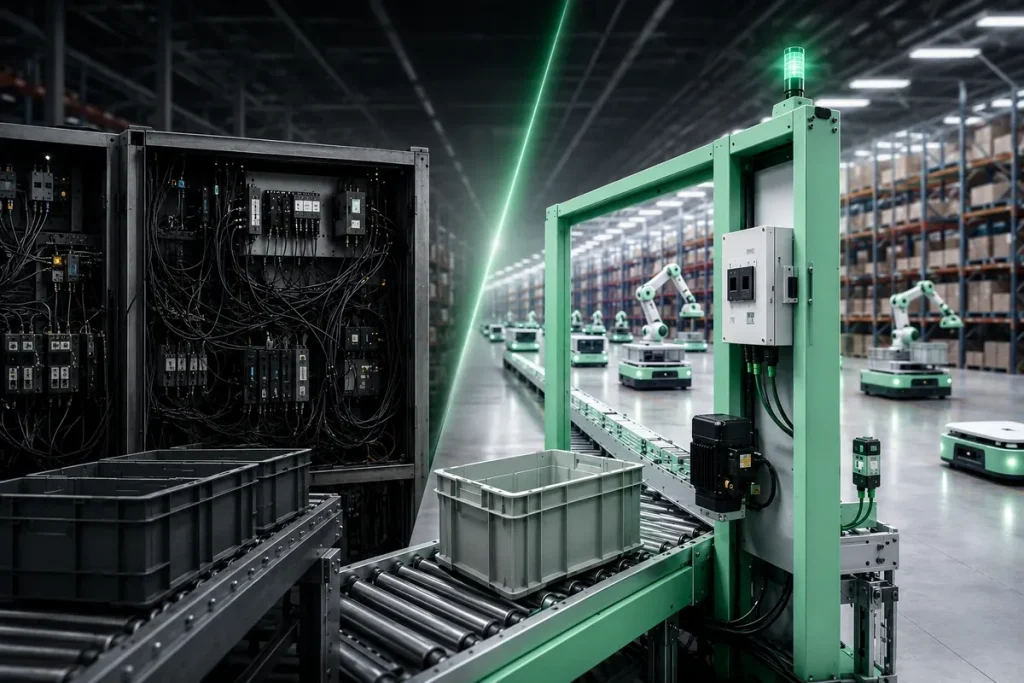
For many warehouse and operations leaders, the question is no longer whether to automate, but how to do it without introducing new risk, complexity, or cost.
On paper, highly customized automation looks attractive: bespoke layouts, proprietary hardware, and tailored features built exactly for a given operation. In practice, these one-off systems often come with long lead times, vendor lock-in, and maintenance overheads that are hard to justify when uptime and responsiveness are under pressure.
By contrast, Commercial Off-the-Shelf (COTS) components and standardized architectures are becoming the default choice for modern automation programs. The trend is visible across manufacturing and industrial technology, not only in warehouses but in how companies structure their entire automation stack.
For Directors of Maintenance, Operations Managers, and CFOs, the core question is simple: Does a standard platform built from widely available parts offer a better long-term position than a custom one-off system? Increasingly, the answer is yes.
Commercial Off-the-Shelf (COTS) in Warehouse Automation
COTS refers to hardware and software produced at scale, sold as standard product lines, and supported by established supply chains.
In a warehouse automation context, that can include:
- Standardized drives, motors, sensors, and controllers
- Common robotic subassemblies and modules
- Widely adopted industrial networks and safety systems
- Software components that are configurable rather than built from scratch
The point is not that the solution is “generic.” The value lies in building blocks that are proven, repeatable, and supported at scale. Configuration, rather than heavy custom engineering, adapts the system to each facility.
This shift toward standardization is evident in broader industrial automation data. McKinsey’s Future of Automation survey found that 54% of respondents now create their Industrial Internet of Things (IIoT) platforms through partnerships with original equipment manufacturers (OEMs), while only 7% use a self-developed IoT platform. That represents a complete reversal of the pattern seen in their 2019 survey and a clear signal that manufacturers are moving away from bespoke stacks and toward standardized, partner-led platforms.
The Hidden Cost of Custom Automation
Custom automation projects promise a perfect fit. But they often introduce challenges that only fully emerge years later.
Lead Times That Drift
When a system is built around bespoke designs and non-standard components, every major change or replacement becomes a mini-engineering project. Facilities remain tied to the original supplier’s capacity, backlog, and supply chain.
In a world where unplanned downtime has become more expensive, this is not a small risk. Siemens’ 2022 The True Cost of Downtime report, as cited by NetSuite, found that Fortune Global 500 companies can lose as much as $1.5 trillion per year to unplanned downtime. An hour of lost production may average $39,000 in consumer goods facilities, while in automotive it can surpass $2 million. At those levels, every additional day spent waiting for a unique part matters.
Vendor Lock-In by Design
Custom systems frequently mean:
- Proprietary controllers and networks
- Specially machined mechanical parts
- Software stacks that only the original integrator can modify
This combination leaves maintenance and operations teams dependent on a single vendor for critical fixes and upgrades. Negotiations, support response times, and long-term roadmaps all have a direct operational impact, but leverage is limited because no compatible alternatives exist.
Maintenance That Never Gets Simpler
When every subsystem is unique, troubleshooting is harder:
- Documentation is specific to one installation
- Spares may be special-order items
- Training must be tailored and repeated for each new hire
Over time, internal expertise becomes as “custom” as the system itself. If key people leave, knowledge gaps appear. For Directors of Maintenance and Operations Managers, that is a structural reliability risk.
Why Standardization Changes the Equation
Standardization does not mean settling for less capability. It means building capability on a platform designed to be reused, supported, and improved at scale.
Availability and Supply Chain Resilience
With COTS-based automation:
- Parts are stocked in established distribution networks
- Multiple suppliers often carry equivalent or compatible items
- Lead times are measured in days or weeks, not design cycles
This connection matters when the cost of downtime is considered. If a critical component can be sourced from several channels, the impact of a failure is limited to the repair itself, rather than the wait for a custom replacement.
Reliability Backed by Fleet Experience
COTS components are tested across thousands of deployments, not just one facility. Failure patterns are better understood, firmware and software updates are rolled out systematically, and design improvements benefit the entire installed base.
For a CFO, that translates into:
- Fewer unexpected engineering charges
- Clearer expectations for useful life and replacement cycles
- Lower risk that a design defect will only surface in a one-off system
Lower Cost Over the Full Lifecycle
A bespoke system might appear competitive at purchase if the project is scoped aggressively. But the total cost of ownership (TCO) for custom automation must include:
- Engineering changes and redesigns over time
- Premium-priced proprietary spares
- Increased dependence on external specialists
- Extended downtime during complex interventions
By contrast, standardized systems benefit from:
- Shared development costs across many customers
- Predictable parts pricing and availability
- Shorter, more repeatable installation and upgrade procedures
The result is often a more favorable TCO profile, even if the initial capital spend is similar.
Parts Sourcing: From Constraint to Lever
For Directors of Maintenance, parts sourcing is where the benefits of COTS components become most tangible.
With standardized components, facilities can:
- Develop critical spares strategies rather than relying solely on vendor stock
- Source commonly used items through multiple distributors and channels
- Align stock policies with actual failure data from their fleets
The Siemens downtime figures underline why this matters. When an hour of lost production can escalate into six-figure costs, having a standard part on the shelf or available the same day from a local supplier can mean the difference between a contained incident and a major financial setback.
Maintenance Simplified: Empowering Internal Teams
Standardized automation architectures make it easier for internal teams to take ownership.
Instead of:
- Unique diagnostic tools
- Custom communication protocols
- One-off safety and control schemes
They work with:
- Familiar industrial networks and devices
- Repeatable diagnostic workflows
- Documentation aligned with widely used standards
The result is faster training, shorter onboarding for new technicians, and less need to bring in external specialists for every issue. For Operations Managers, this also supports more predictable staffing and shift planning, because core maintenance tasks can be handled in-house.
Deployment and Scaling: Speed as an Asset
Standardization is not just about parts; it is about how fast facilities can move.
Industry surveys show that investment in automation is continuing to accelerate. The 2025 MHI Annual Industry Report found that 55% of supply chain organizations plan to deploy robotics and automation within five years. This highlights how widely automation is now expected to be part of standard operations.
In that context, COTS-based standardized systems provide a practical advantage:
- Deployment: Implementation is based on proven designs and repeatable playbooks rather than first-time engineering.
- Scaling: Adding capacity usually means adding more of the same modules, not redesigning the system.
- Change: Software and configuration updates can be rolled out across multiple sites without rebuilding hardware foundations.
For a CFO, this reduces the variance between the business case and actual outcomes. For Operations Managers, it ensures that expansion plans are constrained by commercial decisions, not engineering bottlenecks.
Why “Proven” Beats “Proprietary”
Proprietary technology is not automatically a problem. The issue arises when “proprietary” also means:
- Only one supplier can provide essential parts or support
- Upgrades and roadmap decisions are driven solely by vendor priorities
- Integration with other systems becomes more complex than necessary
By contrast, a “proven” standardized platform is characterized by:
- Transparent performance benchmarks across multiple deployments
- Clear, documented interfaces with Warehouse Management Systems (WMS), Order Management Systems (OMS), and other enterprise tools
- Stable, well-supported components that are regularly updated and improved
The automation market is steadily moving in this direction. McKinsey’s analysis notes that manufacturers increasingly favor partnerships and standardized integration for their IIoT platforms, reflecting a preference for architectures that are open and repeatable rather than bespoke and closed.
Balancing Standardization with Customization: The Software Layer
Choosing COTS and standardized architectures does not mean sacrificing operational fit. The balance has shifted from custom hardware to configurable software and workflows.
In practice, this often looks like:
- A standard, modular hardware platform (robots, conveyors, shuttles, lifts)
- A software layer that orchestrates work, whether batch or real-time, including allocation rules, prioritization, and exception handling
- Integrations with WMS/OMS that exchange orders, inventory status, and performance data in real time
This approach enables facilities to:
- Keep hardware maintainable and supportable
- Tailor workflows to different business units, clients, or product lines
- Evolve logic and algorithms as operation changes, without rebuilding physical systems
For Directors of Maintenance and Operations Managers, this separation makes it easier to plan upgrades: hardware cycles and software cycles can move at different speeds, aligned with their respective lifetimes.
Choosing the Right Path for Your Facility
The decision between COTS-based standardization and custom automation is ultimately about risk, resilience, and control.
- If uptime is critical and maintenance resources are limited, standardized platforms reduce exposure to single points of failure.
- If your network of facilities is growing, repeatable architectures make it easier to replicate success from one site to another.
- If you need a clear TCO story for investment committees, standardization provides better predictability for both capital expenditure and operating expenditure.
The broader industrial trend supports this direction. Manufacturers are partnering with OEMs on standard IIoT platforms and seeking open, interoperable systems that can be deployed and scaled quickly rather than engineered from scratch.
Cartesian Kinetics follows this philosophy in its retrofit-first, rack-native approach to warehouse automation. By building Omni Rack Robotics solutions that work with the racks and infrastructure you already own, Cartesian Kinetics delivers standardized, repeatable platforms whose behavior can be configured and refined in software instead of locked into one-off hardware designs.
For Directors of Maintenance, Operations Managers, and CFOs evaluating their next automation step, the question is no longer whether COTS and standardization are “good enough.” The question is whether you can afford the risk profile of anything else.
If you are assessing how to modernize your facility with a standardization-led strategy, contact us to explore what that could look like in your operation.
