
Legacy WMS Integration: Why Your Old System Isn’t a Dealbreaker for Automation
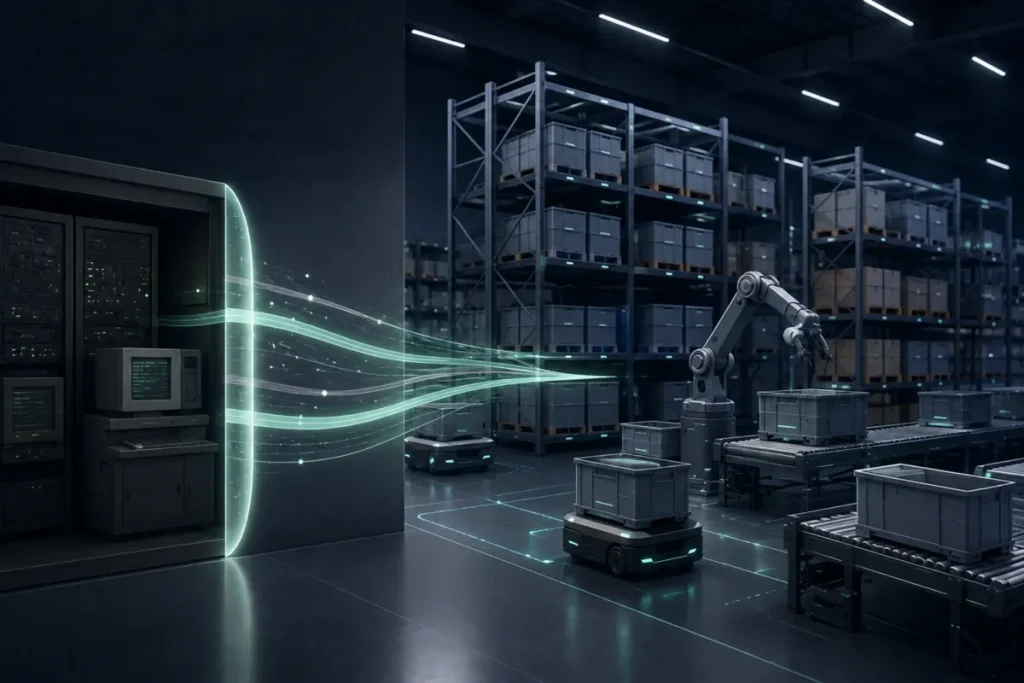
If you run IT or operations in a distribution center, you’ve probably heard some version of this sentence: “We’d love warehouse automation, but our WMS is too old. We have to replace it first.”
That sounds reasonable. But here’s the truth: most enterprises still run legacy systems at the core of their operations. Industry commentary regularly notes that these applications remain widespread and that full replacement projects are among the most expensive and risky in IT. In other words, if “old” systems were a dealbreaker, almost no warehouses would be automating today.
The Objection: “Our WMS Is Too Old for Automation”
A warehouse management system (WMS) is the operational brain of the warehouse. It controls inventory, directs work, and orchestrates fulfillment from receiving through shipping. Gartner defines a WMS as software that manages and intelligently executes the operations of a warehouse, distribution center, or fulfillment center.
Because it’s so central, leaders often worry that:
- The WMS is too customized to integrate safely with automation.
- It lacks APIs or event streams to support real-time robotics.
- Any change could destabilize core operations and SLAs.
Those are valid concerns. But they are concerns about how you integrate, not about whether you can.
Low-Touch Integration: Design Around (Not Through) the WMS
Modern digital transformation patterns rarely start with “rewrite your core system.” Instead, they focus on wrapping legacy systems with integration layers, such as APIs, adapters, and middleware that expose only the data and events you need. Experts in legacy modernization often recommend abstraction layers and API-based integration so organizations can add new capabilities without replacing their core systems.
For warehouse automation, that approach means:
- Treating the WMS as the system of record for inventory, orders, and tasks.
- Exchanging small, well-structured messages (orders, picks, put-away tasks, confirmations) rather than embedding automation logic directly into the WMS.
- Minimizing changes to the WMS itself, favoring low-touch integration instead of major internal surgery.
Cartesian Kinetics follows this philosophy. The goal isn’t to turn your WMS into an automation platform. The goal is to let your WMS keep doing what it does best, while a specialized automation layer handles high-frequency orchestration.
Warehouse-in-a-Warehouse: How CarteCloud Shields Legacy Systems
Cartesian Kinetics uses a powerful pattern called the “warehouse-in-a-warehouse” concept, enabled by CarteCloud.
Instead of automating the entire building in one shot, automation is deployed zone by zone; for example, a fast-moving SKU area or a specific client’s inventory in a 3PL fulfillment environment. To the WMS, each zone is simply another logical location or work area:
- The WMS assigns orders or waves to that zone.
- CarteCloud and the automation layer break those orders into robot tasks.
- The automation layer sends back confirmations (picked, packed, replenished) in formats the WMS already understands.
This keeps the integration surface narrow and predictable. Your WMS does not need to understand robots, bots, or Omni Rack Robotics. It only needs to recognize that work is being completed in a particular zone with better speed and accuracy.
The Layered Stack: WMS, WES, and WCS Explained Simply
Industry resources commonly describe three primary layers in a modern warehouse stack: WMS, WES, and WCS.
- WMS (Warehouse Management System): The planning and inventory layer. It decides what needs to happen: which orders to release, which locations hold stock, and what waves or batches to create.
- WES (Warehouse Execution System): The orchestration layer. It decides how and when work should be executed to meet service levels, allocating tasks to humans, robots, and automation based on real-time conditions.
- WCS (Warehouse Control System): The device control layer. It communicates directly with conveyors, shuttles, sorters, and other material handling equipment, managing how machines move items.
Analysts note that WES has evolved to fill the gaps between WMS and WCS, especially in automation orchestration and multi-system integration.
For legacy WMS environments, this is good news: you don’t have to turn your WMS into a WES or WCS. You simply add those layers alongside it.
How Modern Automation Works With Legacy Systems
In practice, warehouse automation projects with legacy WMS platforms use a handful of proven integration patterns:
- File-based or message-based integration: Many legacy systems already support batch exports and imports of orders, tasks, and inventory. A WES or middleware layer can convert these into near-real-time messages for robots and then back again.
- API or iPaaS connectors: Where APIs exist, lightweight integration platforms (iPaaS) can normalize formats and connect WMS events to automation platforms without deep custom coding.
- Zone-based logic: The WMS only needs to know that a certain zone is automated. Work is assigned to that zone, and the automation layer handles the rest.
Cartesian Kinetics’ low-touch philosophy uses a layered, standards-based integration model so even older WMS platforms can participate in automation without major rewrites.
Multi-Tenant Reality: Making Automation Work for 3PL Fulfillment
If you’re a 3PL, you may have multiple WMS instances or even different WMS brands per customer; you often operate shared facilities where automation must serve many clients at once. And because contracts are time-bound, you can’t justify five-year ROI horizons.
Industry commentary on warehouse software stresses the need for platforms that coordinate multiple systems, including WMS, WES, WCS, robotics fleet managers, and middleware, into a unified ecosystem.
Migration vs. Integration: When to Replace and When to Wrap
Replacing a core WMS is a major legacy system modernization project. Analysts frequently advise that modernization should be driven by business need and risk, not by trend. In many cases, wrapping and extending legacy systems is a better path than replacing them outright.
For automation, you often get better risk–return by:
- Integrating around the WMS first, using low-touch connectors and a WES/WCS layer.
- Proving value in a single zone or “warehouse-in-a-warehouse.”
- Using the resulting productivity and quality gains to fund and de-risk any eventual WMS upgrade.
By decoupling your warehouse automation roadmap from your WMS replacement roadmap, you avoid tying two complex projects to each other’s timelines and risks.
Real-World Examples of Legacy WMS Integration
In practice, the following types of “old” systems integrate well with modern automation when the right patterns are used:
- Mainframe or AS/400-based WMS with flat-file exports and scheduled jobs.
- Early-generation ERP WMS modules (for example, older SAP or Oracle WMS releases) that support IDocs, message queues, or staged tables.
- Heavily customized, home-grown WMS with stable batch interfaces and clear file layouts.
In each case, the WMS remains the authoritative ledger, while a WES/WCS stack and automation platform handle real-time optimization and device control.
When You Really Should Upgrade Your WMS
There are situations where “integrate around it” stops being enough. You should consider a WMS upgrade when:
- The system is no longer supported, creating security and compliance risk.
- You lack even basic integration points such as reliable file exports/imports, stable tables, or messaging.
- The data model can’t represent the inventory granularity or process controls you need (for example, lot/serial control, multi-owner inventory in 3PL fulfillment).
- Reporting and visibility are so limited that you can’t measure the value created by automation.
Even then, you don’t have to wait for the WMS project to finish before starting automation. A layered architecture lets you integrate automation with the old WMS, design your new WMS to connect to the same WES/WCS/automation interfaces, and cut over the WMS while keeping the automation layer stable. This reduces your risk from two simultaneous big-bang projects to one manageable step at a time.
Use Your Legacy WMS as a Foundation, Not a Roadblock
Most enterprises still rely on legacy systems, and warehouse management is no exception. Analysts continue to emphasize that WMS remains a critical foundation for efficient operations and customer experience, even as vendors add new automation and AI capabilities around it.
For IT directors, CTOs, and operations leaders, the key mindset shift is simple:
- Your old WMS is not a dealbreaker for warehouse automation.
- With a low-touch integration approach, a warehouse-in-a-warehouse pattern, and a layered WMS, WES, and WCS architecture, you can deploy automation today and modernize your core on your own terms.
Cartesian Kinetics’ Omni Rack Robotics and CarteCloud are designed for exactly this reality: brownfield warehouses, legacy WMS platforms, and multi-tenant 3PL environments where waiting for a perfect, brand-new stack isn’t an option.
Instead of asking, “Is our WMS too old for automation?” the better question is: “What’s the simplest integration surface we can expose so our existing WMS can start orchestrating a more automated, resilient warehouse right now?” Contact Cartesian Kinetics if you need help mapping that path.
