
What Is Omni Rack Robotics? The Emerging Category Transforming Warehouse Automation
Warehouse automation is no longer a “nice to have.” Labor shortages, higher customer expectations, and space limitations are pushing facilities to do more with the buildings they already operate in. A recent McKinsey survey of logistics and supply chain executives found that 70% plan to invest around $100 million in automation over the next five years, with primary goals of greater speed, process stability, and reduced reliance on labor.
At the same time, the latest MHI Annual Industry Report shows that robotics and automation are among the technologies expected to see the fastest adoption across supply chains in the coming years.
The challenge is clear: most warehouses are brownfields. They contain legacy racking, mezzanines, high‑bay storage, narrow aisles, and floors never designed with robots in mind. Omni Rack Robotics (ORR) is an emerging category built to address exactly that reality.
Defining Omni Rack Robotics
Omni Rack Robotics is a category of warehouse automation built around a simple principle: the racks that store inventory become the core of the automation platform.
An ORR system:
- Mounts directly onto existing racking, such as standard, mezzanine, or high-bay, without rack replacement, floor preparation, or new structural work.
- Works with the totes, cartons, and cases already in use, rather than enforcing proprietary containers.
- Delivers goods-to-person performance by turning static racking into a high-throughput picking and replenishment system.
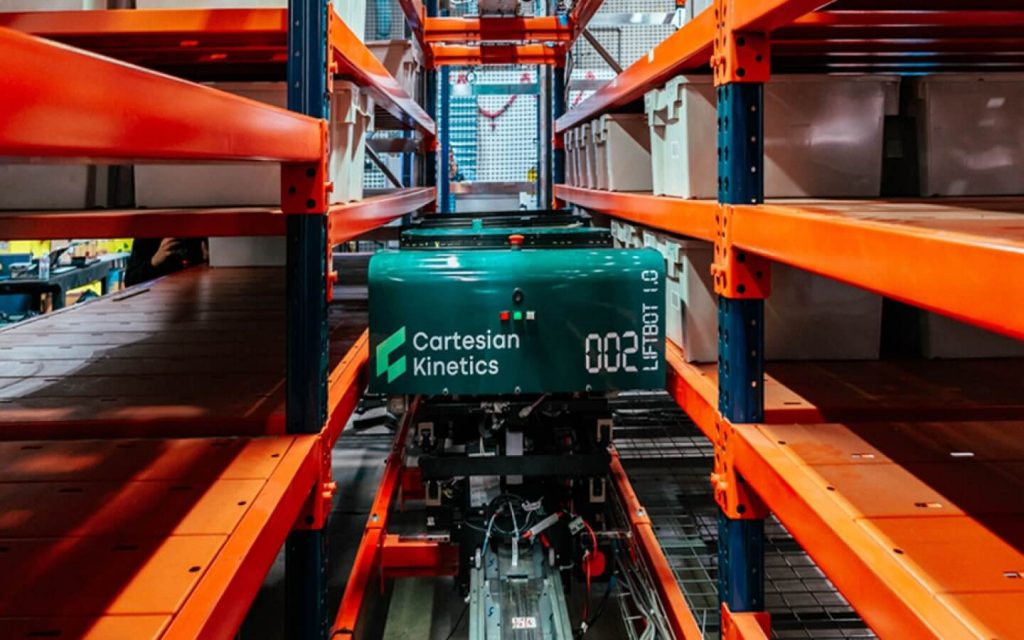
In this category, Carte+ stands as the first fully realized ORR system. It is positioned as a high-performance picking and replenishment solution that can increase picking productivity by up to five times, reduce cost per pick by around 50%, and be installed in approximately four to six weeks. Unlike traditional automation projects, it scales one aisle at a time instead of requiring a full‑site build‑out.
How ORR Differs from AMRs, AGVs, and Traditional ASRS
Most automation programs today rely on three familiar technologies: Autonomous Mobile Robots (AMRs), Automated Guided Vehicles (AGVs), and traditional Automated Storage and Retrieval Systems (ASRS).
AMRs and AGVs operate on the floor. They are flexible and relatively quick to deploy, but they add vehicle traffic to the same space where people, lift trucks, and pallets already move. ASRS, in contrast, delivers high performance and dense storage, but it typically requires new rack structures, strict floor specifications, and longer construction timelines.
Omni Rack Robotics differs in three ways:
- Rack-native motion: The primary movement occurs on the racks and in the area above them. Bots run on rails attached to the racking and transfer between aisles through an overhead path. Floor space is left for people, pallet moves, and staging.
- Retrofit-first design: ORR systems are engineered to work in brownfield conditions: legacy racks, narrow aisles, mezzanines, high bays, and imperfect floors. The goal is to upgrade existing infrastructure rather than replace it.
- Performance comparable to ASRS, deployed with AMR-like flexibility: ORR supports high-throughput, goods-to-person workflows while allowing facilities to automate one aisle, one mezzanine block, or one high-bay zone at a time. Capital investment and operational risk can be phased instead of concentrated in a single project.
For warehouse, operations, and technology leaders, ORR becomes a middle ground: more structured and rack-centric than AMRs or AGVs, yet more adaptable and retrofit-friendly than traditional ASRS.
The Three Core Components: Bots, Overhead Paths, and Lifts
Within the Omni Rack Robotics category, the physical solution is built on three main components, supported by rails and control software.
Smart Bots on the Racks
Compact, high-speed shuttles travel along rails mounted directly to the racking. They move horizontally and vertically to retrieve and store totes or cartons at defined locations. Depending on the facility layout, bots can deliver to pick walls, conveyor interfaces, or buffer zones feeding goods-to-person stations. This design shifts most of the travel inside an aisle away from human operators and into the automation layer.
Overhead Path Between Aisles
Above the rack rows, a powered overhead path allows bots to transfer between aisles. Because this movement is elevated, it does not interfere with traffic at floor level. Aisles can remain narrow, and the floor can be reserved for pallet handling, staging, and other human-driven activities. This feature is particularly valuable in narrow-aisle and Very Narrow Aisle (VNA) configurations where floor robots would struggle to operate efficiently.
Integrated Vertical Lifts
Vertical lifts connect different rack levels. Totes and cartons move between lower and upper positions and synchronize with shuttle movement to keep the flow continuous. This vertical component enables automation to exploit the full height of high-bay racking or multi-level pick modules without reintroducing cranes or heavy lift equipment.
These elements are coordinated by control software that adapts to changing order patterns, SKU mixes, and peak demand. The software can integrate with an existing Warehouse Management System (WMS) or Order Management System (OMS) or run in standalone mode. A digital twin model further extends these capabilities by replaying real order history, validating throughput and return on investment (ROI), testing workflows, and commissioning changes virtually before any adjustments to physical hardware.
Why Existing Racks Become the Automation Infrastructure
A defining characteristic of Omni Rack Robotics is that the racks themselves become the automation infrastructure.
Instead of tearing down pick modules or high-bay aisles and replacing them with new structures, ORR projects focus on:
- Mounting rails to the rack uprights
- Adding lifts at designated locations
- Installing an overhead path that links aisles
- Integrating the bots and software with existing OMS and WMS
Because the system is designed to work with standard racks, mezzanines, high bays, and mixed floor conditions, it is suitable for brownfield facilities that cannot tolerate lengthy shutdowns. Installations are measured in weeks rather than quarters, and sequencing allows operations to remain active while individual aisles or zones are automated.
For warehouse managers and operations managers, this means the building does not have to be redesigned around automation. For technology directors, it provides a clear path to scale: deploy in one area, validate performance, then extend the system across additional aisles or mezzanine levels as demand and budgets allow.
Where Omni Rack Robotics Delivers the Most Impact
Omni Rack Robotics is particularly well-suited to several common warehouse scenarios.
Pick Modules and Mezzanines
Multi-level pick modules with low ceilings and dense racking are difficult to automate with traditional systems. ORR allows rails, bots, lifts, and overhead paths to be installed directly on those structures, supporting high-velocity order picking and batching without new construction. Documented deployments have shown labor requirements drop by more than 80%, with ROI achieved in roughly eighteen months.
High-Bay Storage
In some facilities, high-bay aisles have effectively gone offline because legacy crane systems are no longer usable. ORR can reclaim those locations by retrofitting rails and lifts on the existing racks. In one documented project, automation restored access to approximately 11,000 totes in high-bay racking and projected full ROI in under three years, without new infrastructure.
Narrow and VNA Environment
Facilities with narrow or very narrow aisles often face a trade-off between storage density and automation. Because ORR keeps robotic motion on the racks and overhead, it can operate in tight clearances while leaving floor-level space for manual or pallet-based activity.
Returns and Reverse Logistics
Returns and reverse logistics are built into the ORR workflow. Operators place returned items into totes, which are then routed automatically to the correct storage locations. This shortens the return-to-stock cycle and reduces the need for dedicated returns staging areas.
Across these scenarios, a consistent pattern emerges. Automation is layered onto the racks that already exist, rather than replacing them.
Put Omni Rack Robotics to Work in Your Facility
Automation investment is accelerating, but most facilities continue to operate within the four walls they already have. Cartesian Kinetics’ Omni Rack Robotics approach aligns with that reality by building automation on top of existing racking rather than starting from a blank slate.
For warehouse managers and operations managers, ORR provides a practical route to increase throughput, reduce manual travel, and stabilize performance without a full rebuild. For technology directors, it adds a rack-native automation layer that can coexist with AMRs, conveyors, and other systems. This layer is supported by a digital twin that de-risks design and change management.
In a market where most warehouses were not designed for automation, ORR is an emerging category built on a different assumption: racks are not the constraint; they are the foundation for the next generation of warehouse performance.
If you are evaluating how to modernize your facility, contact us today to explore how this approach can be applied in your operation.
