
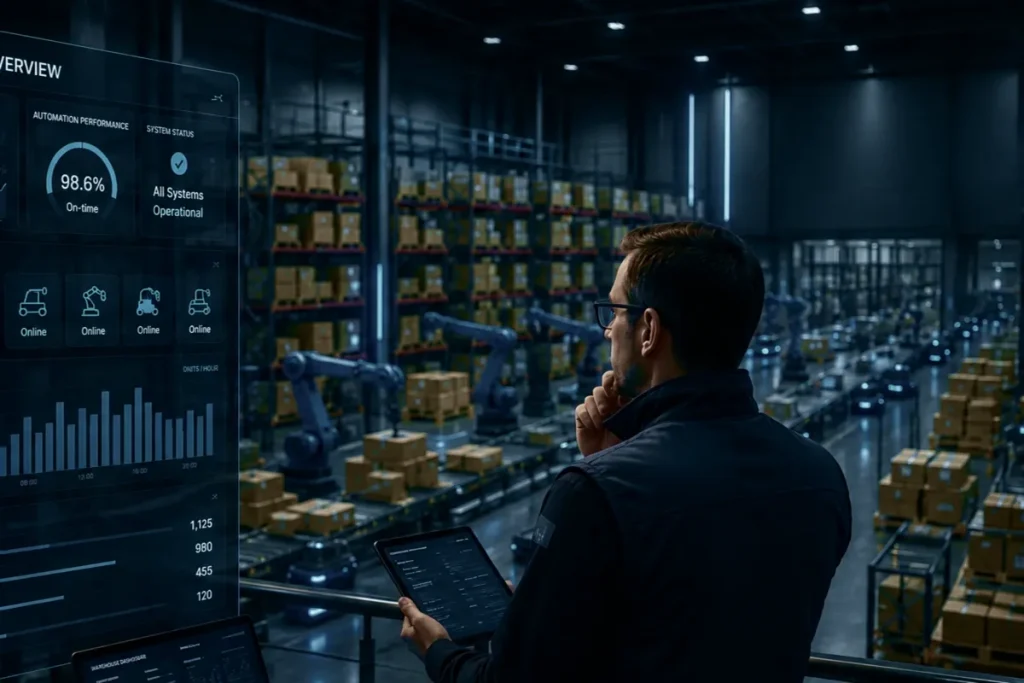
Automation demos are built to impress. Robots glide across racks, totes move on cue, and the throughput numbers match the ones in the proposal. What the demo never shows is the layer that decides whether go-live is smooth or painful: how the automation system talks to the WMS.
For a 3PL, that layer carries more weight than the hardware. One WMS often serves many clients, each with its own rules, SKUs, and service levels. The integration model has to hold all of it together from day one. Gartner names integration complexity, where warehouse automation combines hardware and software from different manufacturers each with its own technology and interface, as one of the central challenges operators face. The systems that struggle rarely fail on the warehouse floor. They fail at the seams between software.
Integration risk cannot be seen in a demo, so buyers have to interview for it. The questions below are the ones worth putting to any vendor before a contract is signed.
Why WMS Integration Decides 3PL Automation Outcomes
Integration risk stays invisible during a sales cycle and becomes unavoidable after go-live. It surfaces in every shift once the system runs against live orders instead of clean test data.
The cost of getting it wrong is well documented. Industry data found that 57% of infrastructure and operations leaders who reported at least one failure blamed initiatives that expected too much, too fast, with data readiness a recurring cause. McKinsey reports that roughly 65% of advanced planning system programs fail to achieve their expected return on investment, with poor data management among the top five reasons. The pattern holds across automation: the technology works, the connection to existing systems does not.
For a 3PL the stakes multiply. A single-tenant operation integrates one set of rules. A multi-tenant 3PL integrates a different rule set for every client sharing the facility. Each new account becomes a new integration test, and the chosen model either absorbs that or fights it.
API vs. Flat-File Integration: Which Fits the Operation
Automation systems connect to a WMS in one of two broad ways, and the difference shapes daily operations.
-
- API integration exchanges data in real time. Orders, inventory updates, and status changes pass between systems as they happen, so the automation system always works from a current picture. It fits operations where order profiles shift through the day or where clients expect live visibility.
-
- Flat-file integration moves data in scheduled batches. The WMS exports a file, the automation system imports it, and the two sync on a set interval. It is simpler to stand up and fits operations where volumes are predictable and timing gaps are acceptable.
Neither approach wins in the abstract. The right choice depends on how the operation runs and what the WMS can actually support. A legacy WMS may not expose the APIs a real-time model needs, and forcing one onto it creates fragility rather than speed. The question for a vendor is not which method they prefer, but which methods they support and how those match the WMS as it exists today.
Handover Tracking Between WMS and Automation System
Once two systems share responsibility for inventory, one of them has to own the truth at each step. Handover tracking keeps the WMS and the automation system aligned as a tote moves from one domain into the other and back.
The failure mode is familiar to anyone who has run parallel systems. The WMS shows an item in one location, the automation system shows it in another, and an operator loses time reconciling two versions of reality. Across a full shift, the productivity gains the operator paid for start leaking away.
Clean handover depends on a defined boundary: where the WMS hands control to the automation system, where it takes control back, and how state is confirmed at each pass. A vendor should be able to walk a single unit through its full path across that boundary. A clear account of where ownership transfers and how both systems confirm it signals a designed handover. A vague answer signals the first source of post-go-live friction.
Exception Handling for Unmapped SKUs and Edge Cases
Demos run on clean data. Real operations run on the items that do not fit: an unmapped SKU, a mismatched dimension, a client onboarded last week whose catalog is not fully loaded. What the system does when it meets something it does not recognize matters more than how it handles the cases it already knows.
Data quality is an operational issue here, not an IT one. Some companies have invested millions in automation solutions that failed to deliver because of incomplete or low-quality data, and returns and multi-client catalogs are exactly where that fragmentation lives. A 3PL absorbing new clients continuously will always have SKUs in flight.
A well-designed system does not halt when it hits an unknown. It flags the exception, routes the item to a human decision, and keeps running on everything else. A vendor should be able to show the exception path directly. What happens to an unmapped SKU, where does it go, who resolves it, and does the rest of the operation keep moving while they do? The answer separates a system built for real 3PL data from one built for a controlled demo.
No-Code and Low-Code Configuration for Multi-Tenant Setups
In a single-tenant facility, configuration is a one-time setup. In a multi-tenant 3PL, it is a continuous activity. Every new client brings different picking logic, different putaway rules, and different service levels, and each one needs to stand up without a code deployment.
No-code and low-code configuration is what makes that pace possible. When client rules live in a configuration layer rather than in custom code, the operator’s own team can onboard and adjust workflows directly. When they live in code, every change waits on an engineering queue, and onboarding speed, the metric growth depends on, becomes hostage to development bandwidth.
Gartner’s guidance on matching WMS functionality to operational complexity captures the risk: misalignment leads either to overspending on unneeded capability or underperforming for lack of the capability the operation actually requires. For a 3PL, complexity comes from multi-tenancy, and configuration flexibility is how operators meet it. The question for a vendor: can the operator’s team onboard a new client and adjust the workflow itself, or does every change mean filing a ticket and waiting?
How Carte+ Connects to Existing WMS Workflows
Every question above points to the same test: can the automation system adapt to the WMS and the workflows already in place, at the pace a multi-tenant operation demands? Carte+, the Omni Rack Robotics platform from Cartesian Kinetics, was built to pass that test rather than route around it. It retrofits into existing racking without a teardown, and its software layer is designed to connect to the WMS an operation already runs.
-
- Low-touch integration connects Carte+ to existing WMS workflows without reworking the systems already running the facility.
-
- No-code and low-code configuration keeps per-client rules in configuration rather than custom development, so new tenants onboard at the pace the business sets, not the pace an engineering backlog allows.
-
- Native exception handling flags unmapped SKUs and routes them for resolution while the rest of the operation keeps running, the behavior a continuously onboarding 3PL needs.
-
- Native multi-tenancy runs independent client workflows on shared automation, so one facility avoids a separate integration project for every account.
The result is an automation layer that adapts to the WMS as it exists, absorbs the volatility of a multi-tenant operation, and holds up against real data rather than demo data.
See the Integration Before the Commitment
The integration questions in this piece are exactly what the eCarte+ Digital Twin is built to answer. It models how Carte+ will run inside a facility, against real workflows and real data, before installation begins. Operators see the handovers, the exceptions, and the configuration in a validated simulation rather than a proposal.